Flood-Affected in the Himalayas Continue to Struggle: A Mentality Story
By Surinder Kumar | Mentality
This article is republished with permission from Mentality.
Due to over-construction in the Himalayas, the frequency of floods, cloudbursts, and landslides have become an annual occurrence. While the victims battle uncertainty, anxiety, and post-traumatic stress, lack of questions on mental health care allows for authorities’ inaction.
As a land revenue official, Balaram Singh had spent a lifetime recording, mapping, and measuring lands in Himachal Pradesh’s Mandi district.
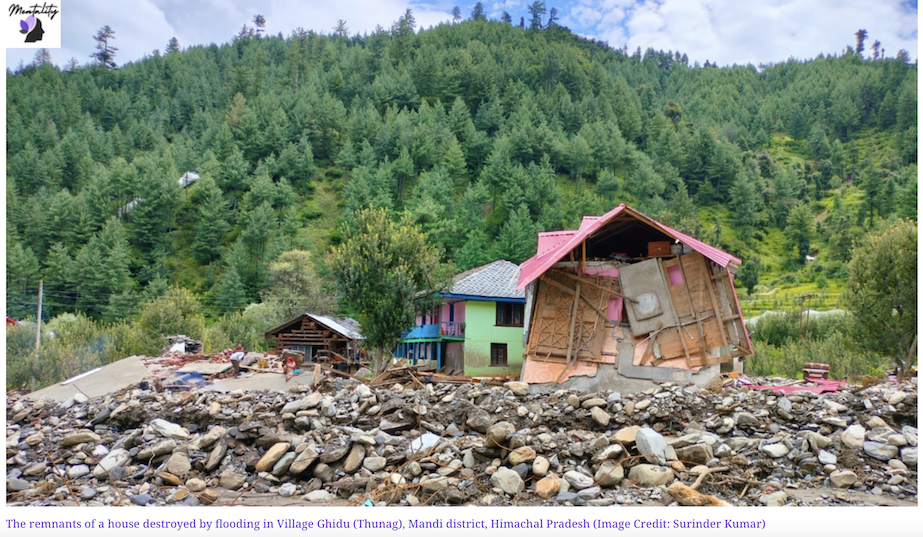
Over three decades, Singh had saved money to build a house and had the foresight to build it further away from river Beas that flows through Mandi. But in June this year, his village of Thunag, approximately 150 kilometres north of capital city Shimla, was engulfed by the river.
The gushing waters took everything in their wake: including Singh’s house and half of his family
Six months later, it is still difficult for 72-year-old Singh to talk about that fateful day when his son, daughter-in-law, and two grandchildren were swept away by the raging Beas, heavy rains, and the landslides that followed. “I still find it difficult to understand what happened,” he said.
According to the Himachal Pradesh Disaster Management Authority, a third of the total 173 people killed in the floods this June were from Mandi. Each of their families has a story of not just loss but of coping with the situation long after the tragic event.
“In Himachal, flood victims are increasingly exhibiting symptoms of post-traumatic stress,” said Guddo Sharma, a mental health professional. Frequent exposure to such climate-related catastrophes is gradually diminishing people’s long-term emotional resilience, he added.
Flooding, an Annual Certainty
In 2023, Shimla, Solan, and Bilaspur districts experienced erratic and heavy rainfall during the monsoons. In 2024, Kangra district faced the wrath of the rains. This year has been particularly trying for Mandi as rains triggered landslides killing three people even as late as September, long after monsoon season was to wane.
“Even after they have repaired their homes or properties, many still expect another disaster to happen to them,” said Sharma, explaining how this keeps many people nervous all the time.
Kamala Devi, 70, is like an industrious ant who never gives up. She built a house in Thunag about five years ago after a lifetime of saving up. The house was washed away by the river a year later. Irrepressible, she built another one immediately after, which was badly damaged by the flooding this year. Her resolve is slowly giving way now.
Devi’s son worked as a taxi driver and his car was washed away by the floods too, taking away his livelihood. “Nobody could have prevented what occurred,” she said. “But I must remain resilient,” she added, almost as a reminder to herself.
Even those who are as resilient as Devi are losing hope, said Som Dev, a volunteer at the Seraj Student Welfare Association at Himachal Pradesh University in Shimla. He has tirelessly helped flood-affected families in Thunag. He said the real way to gain mental strength would be for communities to come together to comfort each other.
Some other symptoms that are common among residents in Mandi are disrupted sleep, increased anxiety during rain, and a lasting fear of losing everything, said Sharma.
The constant fear of losing everything can be crippling. But it is worse if that almost comes true. Bhupendra Chauhan, a 33-year-old hardware store owner in Thunag, experienced that in June.
The evening of 30 June was like any other for him. He parked his car near his store, with his wife, a three-year-old son and a nine-year-old daughter still sitting inside it. He stepped out to phone his father. He said it seemed like he was suddenly engulfed by fierce waters of the Beas. “Everything changed in just half a minute,” he said. His car was drowning, taking his family with it.
In actuality, while it might have taken time for the water to fill up his car, it is the way Chauhan remembers it that matters to his mental health. “I pulled my kids out of the car one by one with great difficulty,” he said.
The family then rushed to safety and sought refuge in an uncle’s house nearby. When they reached the place, they found twenty more people there. “It was a long night,” he said and remembered how they were all huddled together hoping the worst was over.
Chauhan said he is not sure what resilience means anymore.
A Man-Made Disaster
The Himalayan mountains, which were once tough to scale, are now over-constructed, said Tikender Singh Panwar, the former deputy mayor of Shimla who has authored three books on urbanisation.
“Many of the settlements are unplanned and in vulnerable areas,” he said. “Construction in active river and stream zones and natural floodplains has significantly exacerbated disaster risks.”
Knowing that the natural disasters are man-made makes it tougher for the inhabitants to face the wrath of nature.
Since the fateful day in June, Bhavana Thakur’s husband has not returned home. “I don’t know where he is,” she said. Her 7-year-old son asks after his father every day. “What am I supposed to say to him?”
The unpredictability of knowing about her husband sits atop the uncertainty of natural disasters in her region. For many, that is the first step to a mental breakdown, said Sharma.
Search and rescue operations were being conducted until July, looking for missing people, using drones and sniffer dogs. Thakur, though, has still not found closure.
Providing Material Support
With the regularity of natural disasters, the authorities have routine ways of providing relief measures as well. Even as the Indian army was assisting victims, Himachal Pradesh Chief Minister Sukhvinder Singh Sukhu announced an immediate relief package of Rs 7 crore in July.
Not one to be left behind, in September, Prime Minister Narendra Modi announced a financial assistance package of Rs 1,500 crore for flood-affected Himachal Pradesh.
In 2024, an action plan on ‘Climate Change and Mental Health’ under the National Programme on Climate Change and Human Health was launched. But its impacts on the ground are not evident yet. Authorities find it hard to address the anxieties of the people. Partially, this is because dealing with the mental health fall out of preventable disasters is not easy, said Sharma.
No matter how tough, merely providing material relief is not enough in these situations, said Panwar, “Psychological support is essential to help them cope with trauma and rebuild their lives with emotional stability.”
The experience of being surrounded by gushing waters lives inside people long after the event. Balaram Singh said he tries to keep himself distracted by tending to his fields or running errands. “I try to keep myself engaged, but the memories continue to haunt me.” The worst is when he imagines his 13-year-old granddaughter’s voice calling out to him, as he walks in his courtyard. “That echo doesn’t fade away.”
Surinder Kumar is a freelance journalist focusing on environment, climate change, rural livelihoods, and policy issues across Himachal Pradesh.
This piece was first published in Mentality here
About Mentality: Launched on 10th October 2025, World Mental Health Day, Mentality aims to shape the discourse on mental health issues in India by investigating their root causes and questioning systems that perpetuate the crises.